An Academic Partnership for Sustainability: Al-Mustaqbal University and UC Davis Explore Solutions for Agriculture, Water, Energy, and Climate
ايمان محمد مهدي
29-08-2026
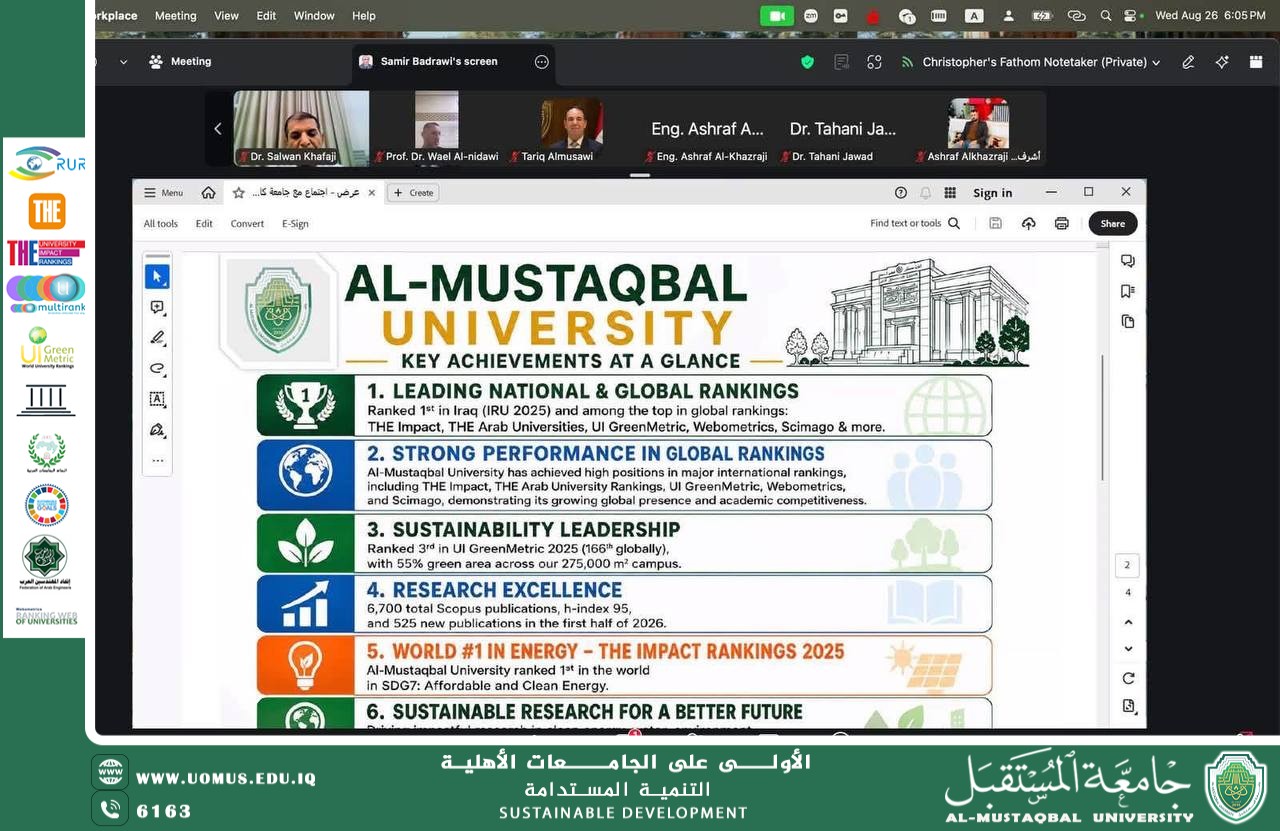


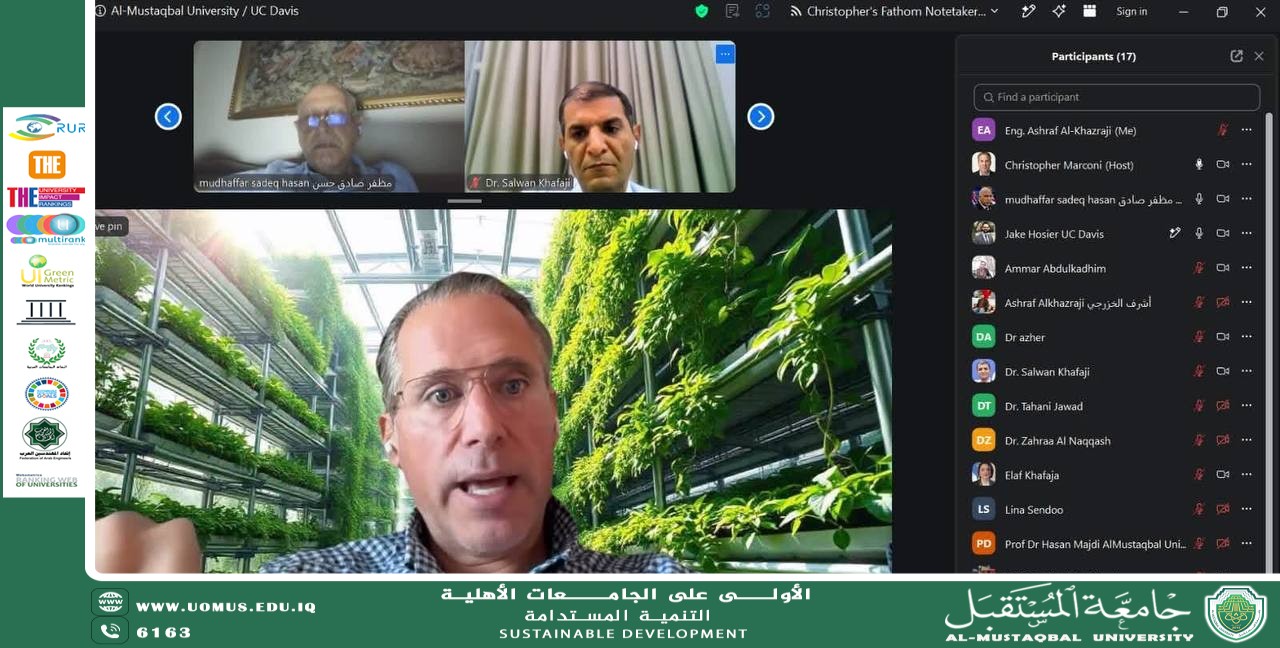
As part of Al-Mustaqbal University’s efforts to advance academic internationalization and expand its network of partnerships with leading global universities and research institutions, the University held a consultative online meeting with the University of California, Davis (UC Davis) in the United States to explore opportunities for strategic cooperation in smart agriculture, water technologies, energy, and climate action, supporting applied scientific research and sustainable development in Iraq.
The Al-Mustaqbal University delegation was headed by the University President, Professor Dr. Hassan Shaker Majidi, and included Professor Dr. Muzaffar Sadiq Al-Zuhairi, Director of Scientific and Academic Supervision; Professor Dr. Azhar Mohsen Abdul, Dean of the College of Engineering Technologies; and a number of directors of departments and research centres. The meeting was also attended by Dr. Zahraa Al-Naqqash, representing the Ministry of Higher Education and Scientific Research.
UC Davis was represented by Dr. Christopher A. Marconi, Director of Business Development and International Programmes, and Dr. Jake Hosier.
At the beginning of the meeting, Professor Dr. Hassan Shaker Majidi presented the University’s vision for establishing an effective international partnership in smart agriculture and sustainable solutions. He emphasized that cooperation with globally recognized and specialized universities represents an important opportunity to strengthen knowledge production, exchange expertise, and develop practical solutions capable of addressing the climate and water challenges facing Iraq and the wider region.
Al-Mustaqbal University also presented an initial roadmap for research and field cooperation, building on the University’s scientific capabilities, infrastructure, and practical experience in the agricultural sector. The proposed areas of cooperation include:
College of Agricultural Technologies: Serving as a scientific and practical framework for supporting applied agricultural projects and research and developing technological solutions for the agricultural sector.
Land Rehabilitation and Green Cover Development: Transforming more than 20 hectares of saline and agriculturally unsuitable land into productive agricultural areas for alfalfa, pasture grasses, vegetables, and date-palm orchards.
Modern Irrigation and Agricultural Systems: Utilizing drip and sprinkler irrigation, plastic greenhouses, and water-efficient hydroponic systems to improve water-use efficiency and enhance local agricultural production.
Organic and Livestock Projects: Operating specialized projects for water-efficient organic mushroom production, in addition to livestock production, beekeeping, dairy production, and related activities.
Community Service and Agricultural Extension: Implementing continuous training programmes and development workshops for farmers and agricultural workers in surrounding areas to promote modern agricultural techniques and strengthen their productive capacities.
Representatives of UC Davis commended Al-Mustaqbal University’s scientific and practical capabilities and its approach to applying academic knowledge to real-world challenges. They also emphasized the importance of maintaining communication and coordination between the two institutions to identify priority areas for future cooperation.
At the conclusion of the meeting, both sides agreed to continue coordination and discussions on developing joint programmes and projects in scientific research, capacity building, smart agriculture, sustainable water-resource management, sustainable energy, and climate action, with the aim of transforming international academic cooperation into practical projects with tangible impact.
This partnership aligns with the United Nations Sustainable Development Goals (SDGs), particularly SDG 2: Zero Hunger, through supporting agricultural innovation and sustainable production; SDG 6: Clean Water and Sanitation, by promoting water-use efficiency and sustainable irrigation technologies; and SDG 7: Affordable and Clean Energy, through advancing research into sustainable energy solutions.
The partnership also supports SDG 9: Industry, Innovation and Infrastructure, by utilizing technology and scientific research to develop innovative agricultural and engineering solutions; SDG 13: Climate Action, through supporting research and practices related to climate-change adaptation; and SDG 17: Partnerships for the Goals, by fostering effective international cooperation among academic and research institutions.
Through this international partnership, Al-Mustaqbal University reaffirms its commitment to strengthening its global academic and research presence and leveraging international collaborations to develop scientific and technological solutions to local and regional challenges. These efforts support the University’s transition towards a Fourth-Generation University and strengthen its contribution to building a more innovative, resilient, and sustainable future.