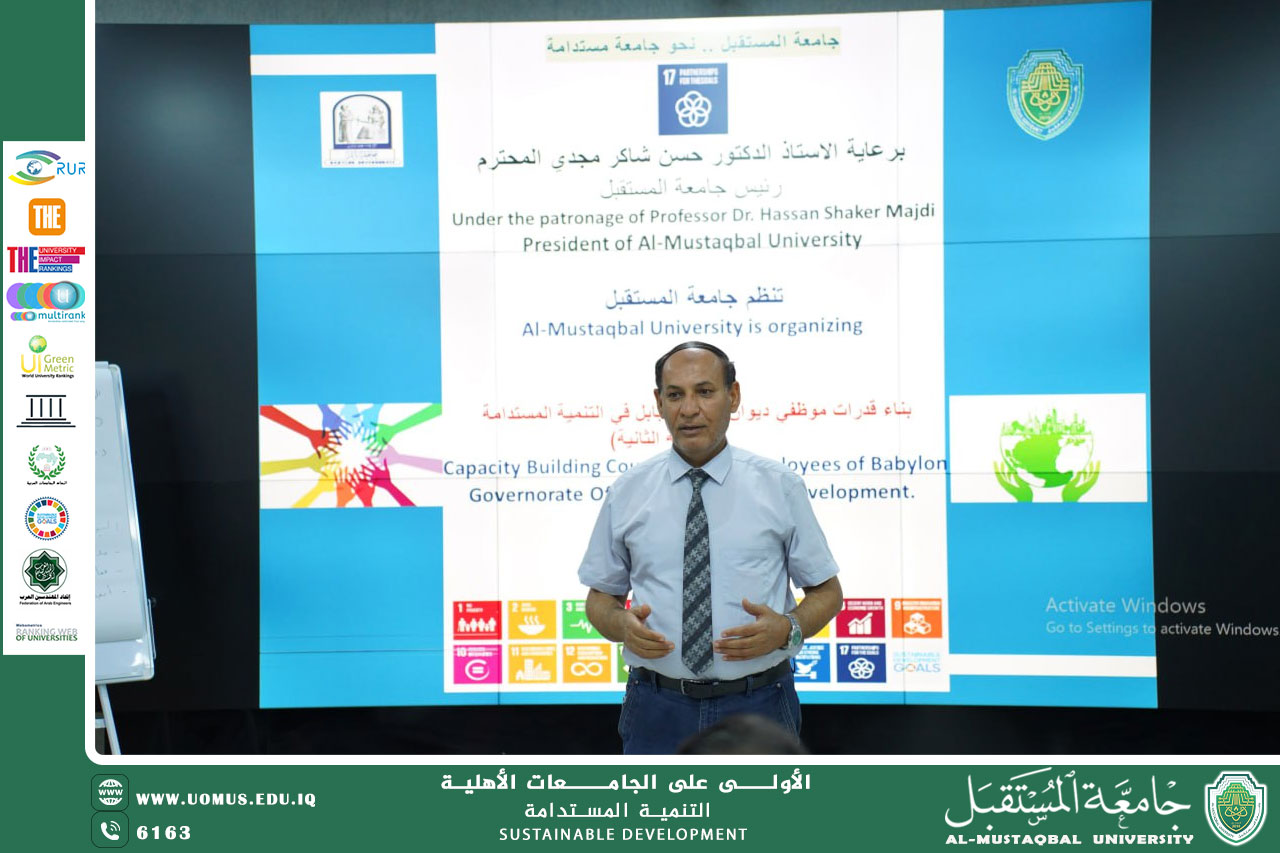
As part of its institutional mission and commitment to community service and sustainable development, Al-Mustaqbal University, under the esteemed patronage of Prof. Dr. Hassan Shakir Majdi, President of the University, organized a specialized training course aimed at building the capacities of staff from the Babil Governorate Office – second cohort – in the field of sustainable development.
The training was organized by the University's Sustainable Development Division, in alignment with the 17th Sustainable Development Goal (Partnerships for the Goals), and aimed to empower local government personnel with the skills necessary for sustainable planning and effective policy-making.
The course covered a range of key topics, including an introduction to the concepts, dimensions, objectives, and targets of sustainable development. It also included practical training on developing an integrated matrix that connects the environmental, social, and economic dimensions of sustainable development, thereby enhancing the ability to formulate a comprehensive development plan for Babil Governorate. Additionally, the program explored mechanisms for identifying development priorities and directing investments in a geographically and sectorally balanced manner to bridge developmental gaps and improve community well-being.
The course was delivered by Eng. Khalid Kazem Al-Salhi, Director of the Sustainable Development Division at the University. He emphasized that this training is part of a broader series of initiatives launched by Al-Mustaqbal University to equip public sector institutions with the tools and strategies of sustainable development, and to build the scientific and professional capacities of government employees. It also reinforces the University’s role as a pioneering academic, research, and community center contributing to comprehensive local and national development.
Al-Salhi affirmed that the University had provided all the necessary technical and logistical support to ensure the success of this specialized training, recognizing the importance of institutional integration in advancing sustainable development efforts and translating them into tangible outcomes on the ground.